Search This Blog
Friday, February 27, 2015
Sunday, February 22, 2015
sikhi ki hai
Sikhi sikhya Gur vichar
(Guru's views (in words) is the teaching (given to the Sikhs)
Aj dushman Ehi Vichar Sikha kolo khatam karna chonda Kyuki j Guru di vichar (sikhia )e Na rahi ta Insan Ander Sikhi Khatam ho jani Hai .
Sikha nu mar k Dekh lia sarh (burn) kar k dekh lia Par Eh Khatam na Hoe .Hun Ehna ne Sikha nu Khatam Karan lai .Sikh di Sikhia hi khatam Karan Di Chal Apna lae hai.Jive Dera vad .Dere Kadi v Amrit nai shkon ge.aam e tusi dekde a sikh v moortia agge mathe ragad de firde a . Guru da Dasia Rasta hi Sikhi hai .j Rasta hi chad ta fir Manzil v hor hi honi hai.
.Plz Share jarur karo
(Guru's views (in words) is the teaching (given to the Sikhs)
Aj dushman Ehi Vichar Sikha kolo khatam karna chonda Kyuki j Guru di vichar (sikhia )e Na rahi ta Insan Ander Sikhi Khatam ho jani Hai .
Sikha nu mar k Dekh lia sarh (burn) kar k dekh lia Par Eh Khatam na Hoe .Hun Ehna ne Sikha nu Khatam Karan lai .Sikh di Sikhia hi khatam Karan Di Chal Apna lae hai.Jive Dera vad .Dere Kadi v Amrit nai shkon ge.aam e tusi dekde a sikh v moortia agge mathe ragad de firde a . Guru da Dasia Rasta hi Sikhi hai .j Rasta hi chad ta fir Manzil v hor hi honi hai.
.Plz Share jarur karo
corruption
Corruption is dishonest actions that destroys people's trust in the person or group, like the news of corruption in how your bank is run, that makes you close your account and invest your money somewhere else.
The noun corruption comes from Latin — com, or "with, together," and rumpere, meaning "to break." Corruption breaks your trustworthiness, your good reputation with others, like the news of corruption in the mayor's office that shocked everyone. When you corrupt something that is pure or honest, you take away those qualities. That's why "corruption of minors" is a serious offense in our legal system.
Friday, February 20, 2015
USA: Sikhs in small Wisconcin city hope to change survey findings
(February 19, 2015)—After many years of wearing a turban, Randee Talwar stopped in 2003.
He was living in New Jersey at the time, and emotions were still exceedingly raw over the attacks by Islamic terrorists on Sept. 11, 2001. It was a difficult time to be Muslim in the U.S. — or to be anyone confused for Muslim.
Such was the case with Talwar, who practices Sikhism, a distinct religion. People swore at him from passing cars and gave him dirty looks on the street. He worried about the safety of his 5-year-old daughter playing in the family’s front yard.
“I was not fearful for myself but for my family,” said Talwar, 46, who now lives with his family in Madison and owns two hotels in the area. “I felt it would be better to keep my religion a private matter.”
New research shows just how uninformed or misinformed most Americans are about Sikhism, the fifth-largest organized religion in the world. In a national survey of 1,144 people commissioned by the National Sikh Campaign, 60 percent admitted knowing nothing at all about Sikh Americans.
The survey also found that people sometimes have difficulty distinguishing between Sikhs and Muslims.
Shown a photo of a turbaned male Sikh, survey respondents wrongly assumed he was Muslim 20 percent of the time.
None of this surprises Talwar or the many others who worship at the Sikh temple in Middleton, called Gurdwara Sahib.
“That survey hits right at the heart of the issue: A lot of people don’t know us,” said Surinder Pangli, a temple board member.
He recalled a post-9/11 incident at a Monona convenience store in which his brother, working behind the counter, was called a “towel head” by a customer and told to go home.
Sikhism is an independent religion, not an offshoot of Islam or Hinduism. It was founded about 500 years ago on the Indian subcontinent.
Its first guru, Nanak Sahib, said he heard God’s call to dedicate himself to the service of humanity. Followers believe in one God and that he is the same God for all people of all religions, just known by different names.
When Pangli meets someone who’s never heard of Sikhism, he first stresses that it’s a religion that doesn’t discriminate. Sikhism preaches that people of different races, religions, or sex are all equal in the eyes of God.
He then talks about the three pillars Sikhs live by: work hard for a living; share what you have with the less fortunate; and remember God every day, all day, in everything you do.
With their belief in one God, Sikhs consider Muslims their brothers and sisters in humankind. So they don’t want to seem as if they’re protesting too much when they attempt to differentiate themselves. Yet confusion between the two religions has had tragic results for Sikhs in this country.
Since 9/11, hate crimes against Sikhs have dramatically increased.
In 2012, a white supremacist shot and killed six people and then himself at a Sikh temple in the Milwaukee suburb of Oak Creek.
“This was a very welcoming country before 9/11,” said Inderbans Brar, another board member of Middleton’s temple. “Whenever you have a big ‘pop’ like that happen, the majority population is going to go into a defensive position and the minority population will pay the price. It’s human nature. We paid a price for 9/11, even though we had no part of it.”
The Oak Creek killings, horrific as they were, did allow Madison-area Sikhs to explain themselves to the media and to neighbors in ways not often available, Talwar said.
He and some of the youth from the temple gave presentations at several area Protestant churches, and they were guests on a WORT radio talk show.
“There was so much interest in us after Oak Creek,” said Balwinder Singh Seerha, president of the temple’s management committee. “We had 40 to 50 people come on one day to see how we worship.”
The temple is at 6970 Century Ave., not far from the Middleton Copps grocery store. About 150 Sikhs worship there on a typical Sunday. Most of the adult members are first-generation immigrants from India, Seerha said.
Guests are always welcome. People typically begin gathering at the temple about 10 a.m. on Sundays for several hours of music and communal prayer. It is customary for people to come and go throughout the morning, Seerha said.
Services are led by a priest, who is a full-time employee of the temple. A free meal follows at 1 p.m.
The national survey uncovered a big upside. Most people are curious about Sikhism, and once they learn more, they usually feel warmly toward the religion.
Roopak Talwar, who works in information technology and is Randee Talwar’s wife, said she has found this to be the case in her interactions with co-workers and neighbors.
“When they find out that we are for freedom and equality and that the religion was founded to get rid of the caste system, they are very receptive,” she said. “These are the values of most Americans.”
Sikh American Float Brings Beauty And Education To The 2015 Rose Parade
LOS ANGELES, CA, USA (February 19, 2015)—Floats in the Tournament of Roses Parade often have a message, but in the case of the United Sikh Mission entry, “A Sikh American Journey,” the message was vital: We are Americans. Tournament of Roses Examiner recently spoke with Minu Kaur Singh, the float’s creative director, about Sikhism and the first Sikh float to roll down Colorado Blvd. in Pasadena on New Year’s Day, 2015.
It was the brainchild of Rashpal Singh Dhindsa, the founder of the charitable organization United Sikh Mission, Minu Singh told us. “He immigrated back in the ’80s and really enjoyed watching the Rose Parade in his home on TV. Since 9/11 when hate crimes against Sikhs increased, he kept thinking what a great idea it would be to have a Sikh float, since so many people watch the Rose Parade and it would bring awareness.”
Through a friend, Rashpal Singh was able to navigate the process of entering a float in the 2015 parade. The theme “Inspiring Stories” was a lucky choice for them, Minu Singh said, because she saw it as a platform to showcase religions and cultures. It worked so well that the Sikh community, which is 700,000 strong in the US, is seriously considering an entry for the 2016 parade as well.
Getting a float in the Rose Parade
The goal of the float was to send a message about who Sikhs are and what they stand for. Singh said the committee considered different ideas, but when she came on board as creative director, it was clear that it needed to portray the Sikh story of more than 125 years in America. She said, “To be honest with you, it was just kind of instantaneous, immediate, we had to tell our history…. We are as much a part as any other American ethnic community.”
When she and other members of the float committee sat down with builder Phoenix Decorating Company to discuss the design, Singh sketched her concept of a pictorial timeline with pencil and paper. Designer Michelle Lofthouse tweaked it, creating a beautiful Rose Parade entry. The float was topped by a model of the first Sikh temple or “gurdwara” (house of worship) in California. Like many immigrants of the time, the Sikhs from Punjab found work building railroads and farming, reflected in the locomotive, tractor and produce depicted on the float.
A Rose Parade float can be an expensive proposition, and a certain amount of funds must be confirmed before the Tournament will accept a sponsor. Singh shared, “That was a big challenge because it’s a very small community here in Southern California. The other thing was that time was very short for us to start a fundraising campaign. It was pretty much word of mouth. It was all community funded, in very short period of time.”
The entry was a collaboration among United Sikh Mission, the lead sponsor, SikhLens, Khalsa Care Foundation, and Sikh American Legal Defense and Education Fund (SALDEF), as well as Sikhs around the country. One effort was a phonation, Singh said, “But the good thing is, I don’t think anyone who received a call minded, they totally believed and wanted to be part of this very unprecedented event of the community.” Many also came out to decorate the float. About 100 members of the Sikh community participated, enjoying the work, interacting with other float volunteers, and sharing who Sikhs are.
Details of the float design and riders are with each photo in the list attached to this article.
Who are the Sikhs?
We asked Singh what is the most important thing for people not acquainted with Sikhs to know. She responded that, in the current environment where both America and the world are facing differences in ideology, “what Sikhs want people to know most about them is who they are and what they stand for, and not to be stereotyped, misunderstood, or be completely unknown and then become a target of bullying and hate or discrimination, or all that comes along when someone gets stereotyped in a bad way. That’s the most important thing the Sikhs want people to know.”
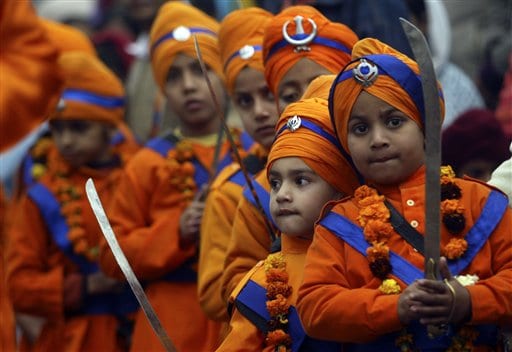
Misconceptions about Sikhs commonly relate to the religious garb they wear, which they call the five articles of faith: kara (a steel bracelet), kirpan (a short sword), kachha (undershorts), kanga (a comb), and most obviously, Singh said, kesh, the uncut beard and hair covered by a turban. The articles of faith represent a Sikh’s commitment to equality, service, and justice. “The message is not just that we are not Muslim, the message is that anyone with the turban and beard is not a terrorist,” she said. “It does not make them a terrorist.”
Sikhism, the fifth largest religion in the world today, was founded by Guru Nanak in the 15th century at a time when Hindus and Muslims in India were fighting with each other. His idea was to shed identities, to become human and lead a life of good morals, to pursue “truthful living.” Singh said, “The ultimate truth is God, but if we don’t have truth of living, we cannot call ourselves a person of God.” She said that many of the people in India who were tired of the religious wars became Sikhs.
It wasn’t until 1699, in response to persecution by the Muslim emperor, that the 10th and last guru Gobind Singh instituted the articles of faith as a way to preserve the Sikh identity and ideals. Seeing the beard and turban, Minu Singh told us, people would know that the person wearing them believed in freedom, justice, and standing against violence and oppression.
In the wake of 9/11, it has become more difficult to retain the articles of faith as violence against Sikhs has increased, and yet for men such as Singh’s husband, who does not carry the sword, it is very difficult to part with them. While most baptized Sikh men carry all five articles, the percentage of those who only keep the turban and beard has risen and many practicing Sikhs do not keep any of the articles.
Equality and service
Baptized Sikh women have the option to carry or not to carry the articles and to wear their hair in a bun rather than a turban. “Within the community, I think people just accept them, whatever they choose to do,” Singh said. She added that Nanak “made it very clear, there is absolute gender equality,” and that he wrote the first document that included a women’s rights statement. “Women are equally entitled,” she affirmed. They can become priests, serve in the temple, and hold offices, including the highest office of granthi.
The message of equality is reinforced by shared meals after each worship service, a tradition that was established in 16th century, when the society was still under the caste system. Singh said, “One of the very strong values of Sikhism is equality. To establish equality is important for people of all backgrounds, castes, classes…. It’s a very big part of every service in every gurdwara.”
The Golden Temple in Punjab, the holiest Sikh gurdwara, feeds 100,000 people every day and is the largest communal kitchen in the world. The design of the temple itself reflects equality, with four entrances to show, Singh said, “In God’s house, no matter what color, what direction, you are welcome. We don’t believe in converting from another religion, but at the same time, we have all these open doors for anybody who would like to come, partake, enjoy, learn and understand who Sikhs are.
She continued, “It’s for equality and also, when you go to guru’s house [the literal translation of gurdwara], we all go with some kind of expectation. We want the guru’s lessons, so we will stay strong, still live by the values and Sikh way of life, and also get a blessing. You feed your mind and your body at guru’s house. We refer to God as our teacher as well, our guru. Our prophets are also guru. God as guru, because we feel he is our guiding light, the source of our guiding, teaching right from wrong, choosing the right path.”
Asked what the most important thing for a Sikh to do is. she replied, “In one word, it would be to serve. The most important thing for a Sikh to do is to serve. It is actually part of our tenets to serve with your body, to serve with your hands, to serve with your mind—essentially talents—, and lastly to serve with your money. But to serve with your hands comes on top, next is mind/talents.”
Sikh Environment Day On March 14, 2015
WASHINGTON DC, USA (February 19, 2015)—As the United Nations gear up for a major global summit on climate change in Paris in December, EcoSikh, a US-based organization out of Washington, has appealed to Sikhs to focus on climate change when they celebrate Sikh Environment Day on March 14 of this year.
Sikh Environment Day coincides with the Gurta-Gaddi Divas (enthronement day) of Guru Har Rai Sahib Ji, the seventh Sikh Guru, who is remembered in Sikh history for his deep sensitivity to nature and its preservation. EcoSikh has been working with the White House and the State Department on climate issues in the US.
“On March 14, EcoSikh will engage the Sikh community in increasing renewable and alternative forms of energy,” said the president of the EcoSikh organization Dr. Rajwant Singh.
He specifically highlighted the role of Gursahib Singh, the team leader of a Ludhiana-based youth group, “Young Flares”, that put in two years of hard labor in greening and cleaning the environment.
The key steps taken included sensitizing Gurdwara managements on discarding the use of Styrofoam plates and returning to steel utensils for langar (community kitchen).
EcoSikh highly encourages Sikhs and everyone else all over the world to go green and join in on the EcoSikh project, and to join in on Sikh Environment day on March 14th.
The Future For Sikhs
NEW YORK, New York, USA (February 17, 2015)—The Sikh traditions have long been at the forefront of social innovation. The founder of Sikhism, Siri Guru Nanak Dev Ji, developed creative solutions to address social and political challenges. He brought forward a fresh worldview that envisioned humanity as a collective family tied together by a single Divine Force, and he created institutions that would bring people together under the umbrella of spirituality, equality, and service.
Over the past 500 years, Sikhs have followed in Siri Guru Nanak Dev Ji’s footsteps and carried on his legacy. The entrepreneurial spirit and commitment to civil society have remained strong, inspiring Sikhs to disperse all over the globe and to serve their communities in all facets of life. At present, the Sikh religion is the fifth largest in the world, with approximately 27 million adherents worldwide.
Yet from an outsider’s perspective, the future of Sikhism might seem bleak. Sikhs continue to be treated like second-class citizens and targeted in violence all over the globe, and for the past few decades the global Sikh experience has been viewed and narrated through the lens of victim hood. This is true in the homeland of Punjab where the Indian Government has perpetrated genocidal violence targeting Sikh communities. This is also true in the Diaspora, where the unique Sikh identity stands out in the public square and marks observant Sikhs as “the other.”
From an insider’s perspective, however, the future of Sikhism looks bright. Sikhs are neither limited to nor defined by the violence they encounter, and the Sikh psyche neither registers the notion of victim hood or sees itself through this lens. Sikhs have traditionally drawn from the spirit of chardi kala, everlasting optimism, and being targeted by misguided bigotry will never be reflective of the state of the community.
While outside observers might sympathize with the Sikhs who face discrimination, the Sikh community does not feel a need for sympathy. Sikhism teaches the importance of actively working against social inequalities, and Sikhs have a long history of persevering in the face of persecution. The Sikh spirit of principled service and justice continues to pulse through the community’s veins, as does Sir Guru Nanak Dev Ji’s empowering vision of spiritual growth, charitable giving, and ethical practice.
Like every religious community, Sikhs have their fair share of challenges. Yet the future of the tradition appears bright. Sikhs continue to establish an equal footing in the global landscape, and the community remains devoted to fighting for equal rights and opportunities on behalf of all people. The future of Sikhism also seems bright because of the vast contributions it has to offer the world.
We live in globalized world where people of diverse backgrounds are interacting with one another more than ever, and it is painfully obvious to all of us that too many people are unable to reconcile different religious or ideological viewpoints. The Sikh tradition has an inherently pluralistic foundation that offers a fresh model for maintaining one’s own religious conviction without imposing it on anyone else.
Sikhs believe that one can follow any number of religious paths to the same ultimate goal, so long as that path is traversed and mediated by the same core values, including love, wisdom, and discipline. This model of open-mindedness and open heartedness also keeps Sikhs from engaging in competitions to proselytize or missionize people.
While it places no emphasis on conversion, the Sikh tradition remains one of the fastest growing religions in the world. Converts cite a number of reasons for joining the community, including the emphasis on equality, social justice, and mindfulness. The rationale often boils down to the fact that people believe the Sikh worldview coheres with their own understanding of what will bring peace and contentment.
Another meaningful contribution that Sikhism has to offer is its perspective on how we engage with the world around us. The Sikh worldview posits that the Divine is equally present in all people and things, and that therefore all of creation should be treated with love and respect. This vision informs a number of ethical practices, from how we treat and preserve our natural environments to how we engage and interact with one another.
The Sikh Gurus rejected social inequalities of all types and advocated for the equal treatment of all people, no matter their gender, profession, or religious background. As our society struggles with increasing social divisions along the lines of race, sexuality, and income, the Sikh outlook of Divine unity has much to offer.
The focus on unity extends to how one views the individual self, another incredibly valuable contribution in our age marked by compartmentalization, multitasking, and disjointedness. The logic of Sikhism compels the individual to maintain a balance in life through which one is nourishing and cultivating the spirit while also being socially and politically active. Service is prayerful action; engaging in social justice is part and parcel of religiosity. This holistic approach brings together the spiritual and the social, and provides a way for us to bring wholeness back into our lives.
The above are some of the unique ideas that the Sikh tradition has to offer the world, ideas that resonate with modern notions of civic engagement, social justice, and mindful practice.
Sikh communities around the world have been working fervently to establish equal footing in civil society and to gain fair representation within political machinery. As the global Sikh community continues to progress, society at large will go beyond seeing Sikhism exclusively through the lens of discrimination and victim hood and will begin appreciating the unique and meaningful contributions that the Sikh tradition has to offer the world.
Subscribe to:
Posts (Atom)